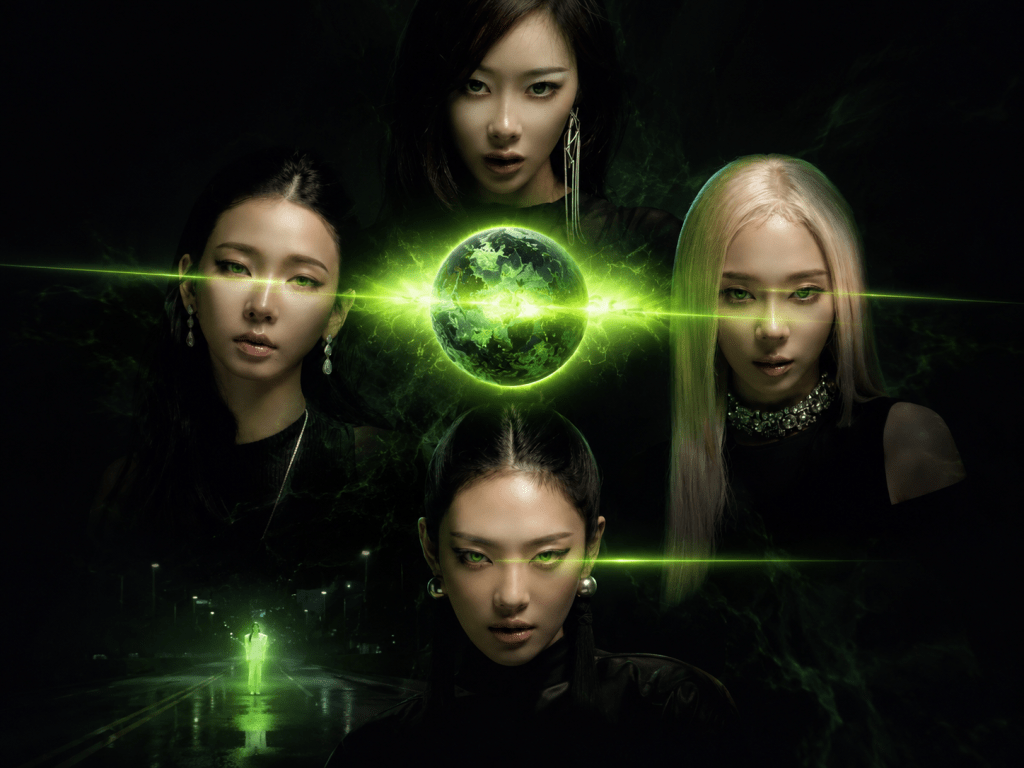
aespa’s WDA does not sound like a comeback teaser. It sounds like something mutating in real time.
The first thing that hit me was not the styling, the visuals, or even the lyrics. It was the music.
Before the song fully opens, there is that distorted sliding bass: minimal, tense, almost cinematic. It does not feel glossy or dramatic in the usual K-pop sense. It feels darker than that — like a warning signal repeating in the background. A small musical movement, stretched and looped until it starts to feel unstable.
Of course, this kind of obsessive repetition is not new for aespa. You can hear that mechanical, looping pressure across songs like Whiplash, Drama and Armageddon, where repeated rhythmic or sonic figures help create that cold, controlled aespa tension. But in WDA, the effect feels different. The bass is not just part of the architecture. It almost becomes the main character on the stage: two suspenseful notes circling again and again, pulling the beat and the voice into their orbit.
Then the beat enters, but not as a full release. It is more like a fake drop: a clapping texture, a percussive layer, something that gives the track shape without letting the tension escape. It is very aespa — artificial, metallic, mechanical, but still strangely addictive.
Then comes G-DRAGON’s voice repeating the title phrase, and suddenly the song has its obsessive centre.
Bass. Clap. Voice.
Again and again.
Like anxious breathing.
What makes WDA interesting is that these elements do not simply return. They mutate. The distorted bass, the clapping beat, the vocal repetitions, the breathing textures — they keep circling back in altered forms, like a thought you cannot get out of your head. The song does not move forward in a clean, traditional way. It keeps changing shape.
That is the key to WDA: it is not just about being different. It sounds like difference becoming physical.
aespa’s production DNA
And this is where my first listening experience became interesting. As soon as I heard the opening bars, I almost automatically started humming Dirty Work on top of it. Then I stopped and thought: wait a minute — did they take that sliding bass and fake-beat energy, sample it, distort it, and turn it into a completely different song?
Of course, that is my listening reaction rather than a technical claim. But even if it is not a direct sample, it feels connected. It feels like part of aespa’s sonic DNA: distorted sliding bass, artificial percussion, repeated rhythmic hooks, and a production style that sounds mechanical but alive.
This is where aespa still feel difficult to imitate. Plenty of K-pop is maximal, experimental or concept-heavy, but aespa’s strongest work makes the production itself feel like part of the world-building. The sound is not just there to support the concept. The sound becomes the concept.
What makes WDA especially interesting is that, on first listen, I could not immediately tell where the verse ended, where the pre-chorus started, or where the chorus was supposed to hit. And I think that confusion matters.
A lot of recent K-pop is built around big structural moments. Huge builds. Heavy drops. Club beats. Chant hooks. Dramatic switch-ups. You can hear this in different ways across groups like BABYMONSTER, BLACKPINK, LE SSERAFIM, ILLIT and IVE, where impact often comes from a clear explosion or release.
But aespa do something different here.
WDA does not give us a major rise and drop, at least not in the usual sense. It does not explode into a massive chorus. It does not suddenly dissolve into a lyrical emotional section either. The G-DRAGON part does offer a break from the obsession, but even that feels like another layer in the system rather than a complete escape from it.
The song stays tense.
It stays compressed.
It keeps repeating.
It keeps mutating.
aespa did not bring all the drama in the obvious way this time. But there is drama in WDA. It is just hidden inside the production.
Bass, synths and vocal machinery
This is where the drama of WDA really sits: not in the arrival of a massive chorus, but in the way that bass figure is treated. The exact pitches matter less than the effect they create: a small musical cell stretched, distorted, repeated and constantly recontextualised.
At one moment, the bass feels exposed and almost skeletal. At another, it is surrounded by claps, synth pressure, breathy vocals and background chants, until the same idea feels larger, heavier, almost orchestral. The track keeps returning to that figure, but it never returns to it in exactly the same condition. It mutates around it.
The synth work adds to this unease. It comes in and out like an unsettling scale, almost following or orbiting the bass. The sound is not warm. It is sharp, artificial, fluorescent. It feels like something digital breathing in the dark.
And then there is the vocal production.
aespa’s voices are not only used melodically in WDA. Sometimes they become rhythm. Sometimes they become texture. Sometimes they become part of the machinery of the song itself.
The anxious breathing, the repeated “crash” and “do it” on the background, and Karina’s “do some’n” doubled vocal delivery becoming almost like an on-repeat beat — all of these details make the vocals feel integrated into the production rather than simply placed on top of it.
And “crash” actually makes the idea even stronger. It is not just a sound effect; it feels like collision. A breakdown. A system glitching under pressure. The word lands exactly where the song’s structure lives: in impact, repetition and instability.
By the end, when the voices layer into the final smoke-and-gunpowder chant, WDA does connect with a wider K-pop trend: the chant ending. But even here, aespa make it feel colder and more digital. It does not sound like a party chant. It sounds like a system overheating.
A whole different animal
This is where the title becomes important.
Whole different animal does not simply mean different. It means a different species. A different category. A different game. It suggests that aespa are not competing by the same rules as everyone else. They are operating in their own environment.
The lyrics are doing the same work as the production.
WDA is not only telling us aespa are different. It is building a vocabulary of transformation: beast, teeth, singularity, glitch, breed, pressure, smoke, gunpowder, crash.
These are not soft images. They are violent, unstable, physical and digital at the same time. Animal language sits next to technological language. Body sits next to system. Mutation sits next to glitch.
That is aespa’s world in one sentence: creature and machine at the same time.
So when the song repeats its title phrase, it does not feel like a slogan. It feels like the result of everything happening in the track. The bass has mutated. The voices have become machinery. The visuals are unstable. The lyrics are describing a body crossing into another state.
Same aespa DNA.
New species.
Visual mutation
And the visuals push this idea obsessively.
Across the WDA and LEMONADE rollout, the members have appeared with animal, mutant and creature-like details: claws, animal references, altered bodies, predatory poses, strange textures. The point is not just that aespa are changing. The point is that they are evolving. They are becoming something else while still remaining recognisably aespa.
Same identity.
New species.
That is why the mutant/animal concept works. It does not feel like a random aesthetic. It feels like a continuation of aespa’s world-building. They are not abandoning their digital, artificial, hyper-stylised universe. They are mutating inside it.
The music video reflects this perfectly.
The camera and direction are constantly distorting, reflecting, reframing and interrupting the image. The camera does not simply record the performance. It behaves like part of the song. In the first part of the MV, the camera almost seems to follow the movement of the bass through its zooms and cuts. It adds and subtracts visual information the same way the music adds and removes layers.
There are close-ups on eyes. Reflections. Bodies falling. Frames within frames. Choreography that feels interrupted or pushed by the camera itself. At some point, the camera literally gets kicked and falls with the movement.
The visuals describe the same deviation from the norm that the music creates.
Lemonade, green screen and transformation
Then there is the fluorescent green.
This also makes the title LEMONADE feel more connected to the mutant imagery than it first appears. Lemonade is not a natural state; it is the result of transformation. Something sharp, acidic and raw is squeezed, mixed and remade into something else. In that sense, the album title already suggests a process: raw material becoming a new form.
The fluorescent green running through WDA plays into that same logic. It is citrus-coded, but also toxic, artificial, acidic, almost radioactive. It connects the sweetness of lemonade with something more chemical and unstable.
But the green screen scenes add an even more interesting layer. A green screen is usually a space waiting to become something else. It is not the final image, but the liminal space before the final image exists. It is where transformation happens before the finished world is inserted.
By leaving that space visible, aespa turn the process of transformation into the concept itself. They are not simply standing in a finished world. They are standing inside a world still being built, still loading, still mutating.
The green screen is not empty.
It is where mutation happens.
So the mutant/animal concept and the LEMONADE concept are not separate. They are two versions of the same idea: aespa in the middle of a reaction. Not finished, not fixed, not fully revealed yet — but changing form in front of us.
Intratextual aespa
This also connects to aespa’s intratextuality.
Intertextuality is when a work speaks to other works, genres or trends around it. WDA does that by responding to current K-pop patterns: chant hooks, heavy beats, impact moments, and expectations around drops and structure.
But intratextuality is when a work speaks to other works within the same artist’s universe. And aespa do this constantly. Their songs and visuals seem to remain in dialogue with their previous eras: Black Mamba, Drama, Whiplash, Armageddon, Dirty Work, and now WDA.
The fluorescent green recalls the toxic digital energy of Black Mamba. The distorted bass connects to aespa’s more recent production identity. The artificial vocal textures and metallic beats continue the sound world they have been building for years. And the obsessive repetition running through the track feels like a darker, more exposed version of the controlled pressure that has appeared across their previous work.
aespa’s concept moves like a prism:
same light, different angle.
That is what makes WDA feel so compelling. It is not different for the sake of being different. It is different because it evolves from aespa’s own internal logic. It keeps the same energy, the same identity, the same digital venom — but shifts it into a more mature, distorted, mutant form.
The pressure before LEMONADE
And maybe that is the point.
WDA does not give us a full release. It keeps us in tension. It feels like an obsessive rhyme stuck in the mind. An earworm. A loop. A pre-chorus that never fully explodes.
So my question is: what if that is intentional?
What if WDA is not meant to be the final explosion?
What if it is the warning signal?
The mutation sequence?
The pressure before LEMONADE?
What if WDA is not the main event, but the door opening into aespa’s next form?
Because if that is what they are doing, then I genuinely think this might be one of the most innovative K-pop productions of the last few years.
aespa are not just changing sound.
They are changing species.
A whole different animal.
A whole different game.
If you enjoyed this deep dive, follow @choeaenotes on Instagram for more K-pop reviews, concepts and comeback breakdowns
Sources consulted
Official release material, music video references, album information, lyric translations and selected coverage were consulted alongside personal listening notes. These included aespa’s official WDA (Whole Different Animal) feat. G-DRAGON music video, Billboard, NME, the aespa Official Store, Teen Vogue, Inkistyle, LyricsTranslate and Just Jared.
These sources were used to confirm factual details such as the release context of WDA, the G-DRAGON feature, its connection to aespa’s second full album LEMONADE, the album-version framing around MUTANT, P.O.S, WDA and LEMONADE, selected lyric references including “beast,” “teeth,” “singularity,” “glitch,” “crash” and “P.O.S,” and wider context around aespa’s long-running digital/worldbuilding concept.
The main interpretation, musical reading, visual analysis and overall argument are my own.


Leave a Reply