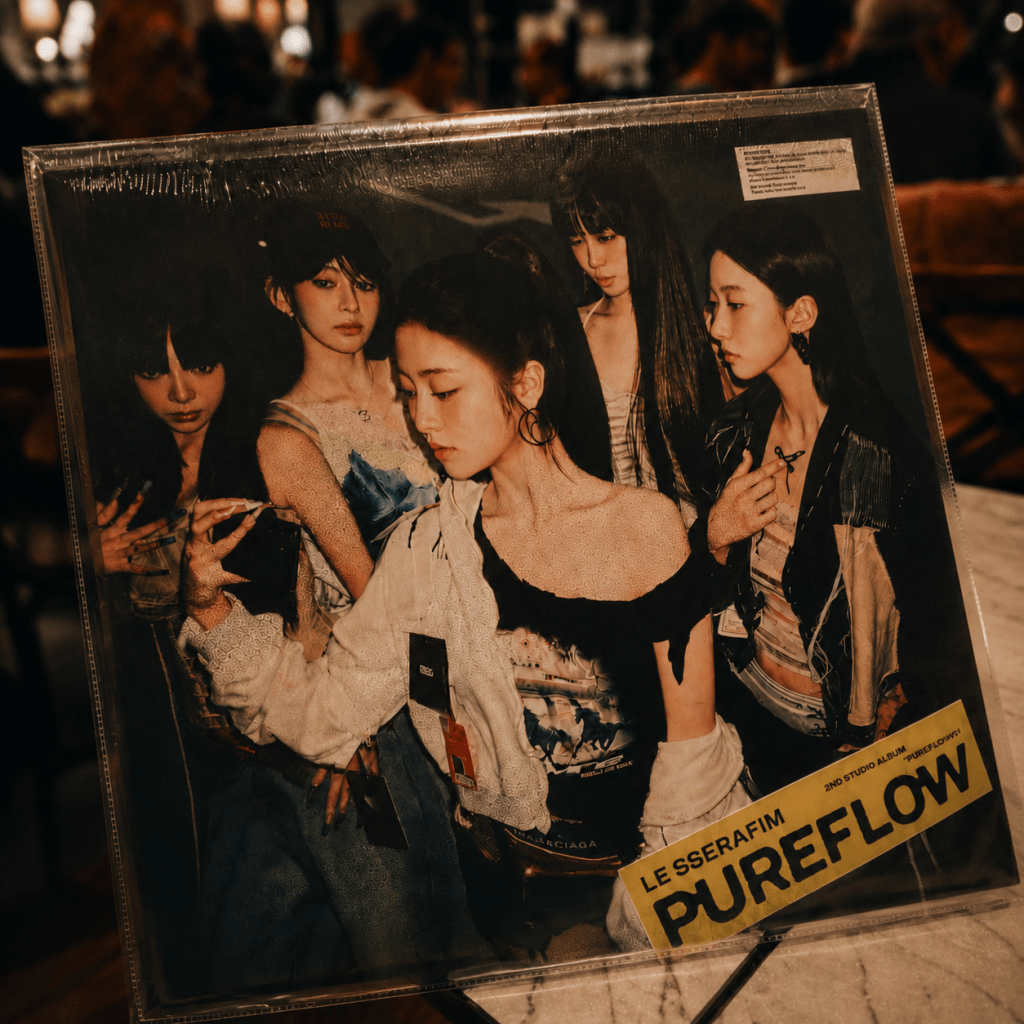
Not fearless — and that is the point
There is something immediately surprising about Pureflow.
For a group whose name has always carried the idea of being “fearless,” this album does not simply repeat that mythology back to us. Instead, it complicates it. The intro’s final message — “For we are not fearless, and therefore powerful” — feels like a quiet reversal of the LE SSERAFIM formula.
Not a rejection of their identity.
A maturation of it.
Because maybe the point was never to have no fear at all. Maybe real power begins when fear, shame, weakness and uncertainty are no longer treated as things to hide. Maybe strength is not the absence of fear, but the decision to move through it anyway.
That is what makes the opening track so important. Pureflow is not just an atmospheric intro. It is the thesis statement of the album.
The text moves across Korean, Japanese and English, and that multilingual structure already makes it feel fragmented, layered and internal. It does not sound like one clean voice speaking from a podium. It sounds like several voices arguing inside the same mind.
At first, the tone is almost cruel. The speaker questions why sadness should be shared, why anyone else should have to carry someone’s pain, why weakness should be visible at all. It sounds like the voice of society, but also like the voice inside your own head when shame has become louder than self-compassion.
That is what makes the intro so striking. It does not begin with comfort. It begins with judgement.
Then slowly, the perspective shifts. The intro stops treating weakness as individual failure and starts treating it as something shared. Everyone is weak inside. Everyone has pride. Everyone knows what it feels like to be ashamed of needing someone.
And then the whole thing turns.
There is a small but devastating Korean line in the intro: “아, 망했다.” It roughly carries the feeling of “ah, it’s ruined,” “it’s a disaster,” or simply, “I’m screwed.” It is casual, almost blunt, but emotionally it lands hard. After all the judgement, shame and pride, the self finally reaches that little moment of collapse.
But the album does not leave us there.
The intro does not resolve pain by escaping it. It resolves it through togetherness. Falling is no longer only a private collapse. It becomes something shared. The wound is not healed yet, but someone is there, close enough to touch it.
That is the emotional key to the album.
Pureflow begins by saying: we are not fearless. We are wounded. We are falling. But we are falling together.
And that is where the power starts.
Pureflow: power in motion
The title itself makes the concept even more interesting. Pureflow is an anagram of “powerful,” and that wordplay matters. It suggests that power is not a fixed pose. It is something in motion. Something running through the body, the group, the music, the fear.
Power is not a statue.
Power is a flow.
That also explains why the album does not always move in a neat, linear way. At first listen, Pureflow can feel scattered. There are hard electronic moments, sweet airy moments, spoken passages, dramatic vocal games, sudden shifts, short tracks that feel like sketches, and songs that seem to arrive and disappear before they fully develop.
But maybe that is exactly the point.
The album does not move like a simple storyline. It moves more like consciousness itself: one thought becoming another, one feeling interrupting the next, one memory triggering a new emotional room. Sometimes the transitions are smooth. Sometimes they are abrupt. Sometimes the songs feel complete. Sometimes they feel like fragments.
That is not necessarily a weakness. It might be the album’s method.
Pureflow sounds like a mind in motion.
BOOMPALA: laughing fear into a dance
After the intro’s internal argument, BOOMPALA arrives like a sudden absurd thought breaking through the seriousness. If the opening track is shame speaking to itself, BOOMPALA is the moment fear gets turned into a joke, a chant, a dance step, a word everyone can repeat until it starts to lose its power.
The Macarena sample is crucial here. Macarena is not just any reference. It is one of those songs that became collective almost by default: millions of people, across different countries and generations, dancing the same choreography together. It is silly, simple, instantly recognisable, and completely communal.
So when BOOMPALA takes that energy and twists it into LE SSERAFIM’s world, it is not only borrowing nostalgia. It is borrowing a collective body memory.
That is why the repetition works. “BOOMPALA” is a funny word. It almost sounds like something you would repeat to mock someone, or to make a situation feel less serious than it is. The hook does not work because it is elegant. It works because it is ridiculous, catchy and social. You can imagine people saying it together, dancing to it together, turning fear into something performative and unserious.
The members’ vocal delivery is one of the best parts of the track. There is an acting quality to it: speaking, singing, teasing, bouncing between tones. They are not only performing a melody. They are playing characters. The voices become part of the song’s absurd theatre.
That acting quality will keep returning across the album. Pureflow is full of voices that do not simply sing. They speak, narrate, recite, whisper, tease, confess and interrupt. The album is not only melodic. It is conversational.
That is why BOOMPALA fits the stream-of-consciousness idea so well. After the intro’s heavy self-interrogation, the mind suddenly jumps into nonsense, movement and mockery. One thought says: I am ashamed. The next says: actually, what if fear is ridiculous?
CELEBRATION: Frankenstein goes techno
Then comes CELEBRATION, and the flow changes again.
If BOOMPALA turns fear into a communal joke, CELEBRATION turns survival into a dance floor.
This is one of the most powerful tracks on the album because it understands celebration physically. It is not a soft emotional concept here. It is a club experience. The techno and hardstyle energy gives the song pressure, build, release and momentum. It feels like standing inside a DJ set, where the music does not simply ask you to listen. It asks your body to respond.
That matters.
Celebrating is not only something humans say. It is something humans have done with their bodies for thousands of years. We dance to mark survival, joy, grief, transition, ritual and belonging. Long before celebration became a caption, it was movement. People gathered, repeated rhythms, moved together, and made life feel shareable.
So the interesting tension in CELEBRATION is that LE SSERAFIM use a modern, machine-driven sound to express something ancient and universal: the need to move together.
Techno’s roots are usually traced to Detroit in the 1980s, before the sound travelled into global club and rave cultures. So CELEBRATION is not just using “club music” as an aesthetic. It is tapping into the collective logic of dance music: the idea that bodies together can become a form of release.
The song feels current because pop seems to be craving collective dance again. BABYMONSTER’s CHOOM is all about surrendering to rhythm, losing yourself in movement, and letting music become the only possible way to exist for a moment. BLACKPINK’s JUMP fits this same movement very clearly: its hardstyle and EDM energy, together with its simple count-and-jump structure, turns the song into a collective physical instruction. It is not just “listen to this.” It is “move with us.” Even outside K-pop, Rosalía’s movement from classical drama into techno release in live performance feels like part of the same wider return to the crowd.
It feels like music is searching for togetherness again.
Not just spectacle.
Not just performance.
Bodies together.
Movement together.
Release together.
The CELEBRATION video makes this idea even clearer. The monster figure is not just a quirky visual. It gives the song a proper narrative. A strange, Frankenstein-like creature is discovered, chased, confronted and eventually brought into the party. In other words, the monster is not destroyed. It is welcomed.
That matters because the album begins with shame: the fear of being weak, ugly, exposed, wounded or too much. CELEBRATION stages another possibility. What if the thing you thought made you monstrous is exactly what gets invited into the room?
The monster does not have to hide.
The monster gets to dance.
So CELEBRATION becomes more than a party track. It becomes an act of inclusion. The private wound becomes a public ritual. The thing that looked frightening becomes part of the group.
And the choreography matters here too. The head-led, headbanging movement in CELEBRATION already makes the body feel slightly creature-like before Creatures turns headbanging into an explicit lyrical command. This is where the album’s physical language starts to connect: fear is not only discussed. It is danced, jumped, shaken, mocked and headbanged through.
Monsters, demons and the self we hide
This is also where Pureflow starts to feel connected to a bigger conversation happening around K-pop right now.
The idea of the monster being welcomed into the party immediately recalls the emotional logic of KPop Demon Hunters. This does not mean CELEBRATION is directly referencing the film. But the two works feel like they are speaking to the same cultural moment: the idea that the monster or demon part of the self is not simply something to defeat, hide or purify.
In KPop Demon Hunters, demon imagery becomes connected to shame, secrecy and the fear of being unlovable if the hidden self is exposed. The emotional movement of the story is not only about fighting external demons, but about accepting the part of yourself you were taught to fear. Until that hidden, monstrous part is acknowledged, the self cannot feel whole.
That makes the monster-party narrative in CELEBRATION even more interesting. The creature is not healed by being made normal. It is not accepted because it stops looking strange. It is accepted as it is. The thing that looked frightening becomes the reason it belongs in the room.
This has always been one of K-pop’s recurring emotional messages: self-acceptance, confidence, learning to love your own difference. But the recent monster/demon imagery makes that message feel sharper. It is not just “love yourself” in a clean motivational sense. It is something darker and more specific: can you accept the version of yourself you were ashamed of? Can you dance with it? Can you let it be seen by others?
In that sense, CELEBRATION does not simply invite a monster to a party.
It suggests that the monster was never outside the story.
The monster was the part of the self waiting to be included.
Creatures: the monster learns to headbang
After CELEBRATION, Creatures makes much more sense as the darker, louder continuation of the same idea.
If CELEBRATION invites the monster into the party, Creatures shows what happens once the monster stops trying to behave.
The track has a rock-pop energy, pushed by the electric guitar and the constant physical language of the lyrics: headbanging, shaking, dancing, breaking apart, jumping around, moving like there is no tomorrow. This is not polished self-acceptance. It is messier, louder and more bodily.
That is why the rock-and-roll reference feels so important. Creatures does not want the monster to become soft or acceptable. It wants the creature to move, shout, shake, break the rules and take up space.
The lyrics also push directly against control. The girls are told to become obedient, decorative and harmless, but the song immediately rejects that. The creature identity becomes a refusal to be trained, owned or made small. They decide their own rules.
This connects beautifully to the album’s wider argument. Pureflow is not saying that power means becoming perfect. It is saying that power might come from accepting the wild, scarred, strange parts of the self — the parts that polite society would rather turn into something cute, quiet or controllable.
The chorus also gives the song another collective layer. To my ear, the repeated shake hook strongly recalls the energy of BABYMONSTER’s Forever, especially in the way the repetition becomes instantly physical and chant-like. I would not frame this as a confirmed reference unless officially stated, but as a listening association it works: both moments use repetition to turn the body into the centre of the song.
And again, this matters for Pureflow.
The album keeps returning to movement as a way of processing fear. BOOMPALA makes fear ridiculous. CELEBRATION turns survival into dance. Creatures turns the monster into a rock performance, almost a mosh pit. It is not just about being invited into the party anymore. It is about realising that the party might be full of creatures too.
That is one of the strongest lyric ideas in the song: the creature is not isolated.
The creature has a crowd.
So Creatures becomes the album’s rougher version of belonging. Not the glossy kind. Not the perfect kind. The scarred, loud, headbanging kind.
Iffy Iffy: some thoughts just pass through
Iffy Iffy is probably one of the weaker tracks for me. It has an 80s or 90s-leaning beat and a certain club-like polish, but it does not leave as much of an impression as the strongest songs on the album.
Even the title feels deliberately uncertain. “Iffy” suggests hesitation, doubt, something not fully convincing or not fully decided.
In that sense, maybe the song still belongs conceptually. It sits in that unstable emotional space where nothing is quite clear. But musically, it does not quite become memorable enough for me. It has atmosphere, but not enough identity.
And that is okay. Not every thought in a stream of consciousness becomes a revelation.
Some thoughts pass through.
Need Your Company → Sonder: from “nobody knows me” to everyone’s universe
Then Need Your Company brings the album back into vulnerability.
The opening idea, that feeling of not being truly known, echoes the intro very strongly. The album began with the shame of sharing sadness; now that loneliness becomes more intimate. It is no longer society’s cruel voice telling you to suffer alone. It is the quieter realisation that maybe nobody fully understands your inner world — and yet you still need someone beside you.
That is what makes the track touching, even if it feels underdeveloped. It is very short, almost demo-like, as if it arrives as a fragment of feeling rather than a fully expanded song. But in the context of Pureflow, that actually works more than it should.
Not every thought arrives fully formed.
Sometimes a feeling appears, says what it needs to say, and then transforms into something else.
And that is exactly what happens when Sonder begins.
This transition is one of the clearest examples of the album’s title actually working. Need Your Company and Sonderalmost feel like they belong to the same breath. One is the need to be known. The other is the realisation that everyone else has an inner universe too.
That is the whole meaning of “sonder”: the sudden awareness that every other person has a life as vivid, complex and private as your own.
So Sonder is not just a pretty title. It is the concept of the song.
The lyrics move from being trapped inside the self to recognising other people’s emotions, worries and entire inner worlds. The self is no longer the only enclosed universe. Everyone else has one too.
That is why the song feels so gentle. It is not soft because nothing is happening. It is soft because perception is opening. The voice processing makes everything feel suspended, airy and slightly unreal, like a thought arriving from somewhere half-conscious. It reminded me of the synthetic intimacy of Imogen Heap’s Hide and Seek: not because the songs are the same, but because both use processed vocals to make emotion feel fragile, floating and strangely close.
Sonder feels like a poem.
A soft one.
A gentle touch.
And honestly, it is one of the songs I love most on the album.
Could it be more developed? Maybe. Like Need Your Company, it almost disappears too soon. But again, that incompleteness fits the stream-of-consciousness structure. Not every emotional realisation becomes a full speech. Sometimes it appears like a flash: I am not alone. Other people are worlds too.
Then it passes.
Saki: confidence as theatre
Saki shifts the album again, this time into performance, confidence and attitude.
It is more aggressive, but it keeps that acting quality in the voices. The members sound like they are playing around with talking, reciting, being sweet, being harsh, showing confidence, almost like they are moving between roles in a play.
The song uses a very familiar K-pop topic: I am the one, I am the game, everyone wants to watch me, gossip all you want, but this is my life and you cannot touch me.
That kind of message is not new, but Saki makes it work through delivery. It is less about lyrical originality and more about character. The voices carry the attitude. The track feels more like an intro or an interlude than a fully developed song, but by this point that also feels in line with the album’s structure.
Pureflow often gives us emotional flashes rather than fully settled statements.
Irony: letting go has a beat
Then comes Irony, one of the strongest tracks on the album.
This is definitely one of my favourites. It has that Latin, almost tribal energy that immediately makes the body respond, but there is also something sharper running through it: a cool metallic, string-like synth that repeats across the track and gives the song its own pulse.
The main melody is great, especially in the pre-chorus, where the song opens up without losing its movement. Ironyunderstands repetition properly. Its central hook works because it becomes bodily before it becomes verbal. You do not only hear it. You feel it looping.
Lyrically, it also fits the album perfectly. The song is about desire, obsession and the pain of trying to hold on too tightly. The more you try to grasp something, the more it slips away. The more you cling, the more it cuts. Then, strangely, release comes through letting go.
That is the irony.
The moment control breaks, breathing becomes possible.
So Irony is not just a fun, rhythmic track. It is another version of the album’s emotional argument. Fear says: hold on. Shame says: control yourself. Obsession says: grasp harder. But the song discovers that freedom might come from loosening the grip.
Trust Exercise: softness has a rhythm
After that, Trust Exercise moves the album backwards in time sonically.
The track feels nostalgic, 80s-inspired and almost fairytale-like. The voices are sweet and airy, sitting over a light synth texture that makes the song feel softer after the physical energy of Irony.
To my ear, the chorus strongly recalls Olivia Newton-John’s Physical.
And that reference actually makes sense.
Because Trust Exercise is also about the body, but not in the same way as Physical. It is not just about movement or desire. It is about emotional timing. One person moves fast, another moves slowly. One wants closeness, another needs time. One approaches, another retreats. The heart is closed, but not empty.
Trust is physical.
It has a pace.
It has distance.
It has hesitation.
It has a rhythm.
That is why the sweetness of the song is not random. After all the album’s chaos, mockery, movement, monster imagery, confidence and release, Trust Exercise asks for something much harder: softness. Can I let someone close without losing myself? Can I move at my own pace and still be loved? Can you wait for me while I learn how to open?
It is a small song, but emotionally it makes sense.
Liminal Space: the hidden recording at the end of the world
Then the album closes with Liminal Space, which might be the clearest expression of the whole concept.
It does not feel like a conventional final track. It feels like a recording we were not supposed to hear. The members remember things, laugh, talk about recording, mention stories only they know, misunderstand each other, cry, tease, question where they are going. It has the intimacy of a hidden device left on in the room.
And that is perfect for Pureflow.
Because this album has always moved between private and collective spaces. The intro is an argument inside the self. BOOMPALA turns fear into a communal chant. CELEBRATION pushes survival onto the dance floor. Creatures turns creaturehood into collective rebellion. Sonder opens the self toward other people’s inner worlds. Irony returns release to the body. Trust Exercise makes closeness slow and physical. And Liminal Space brings everything back to spontaneous conversation.
The album ends not with a grand conclusion, but with people talking.
Still moving.
Still changing.
Still not entirely sure where they are going.
That uncertainty matters. A liminal space is an in-between space: not the old place anymore, not the new one yet. That is exactly where LE SSERAFIM seem to be on this album. They are no longer simply performing fearlessness as an image. They are asking what comes after that image cracks.
Final thoughts: therefore powerful
Maybe that is why Pureflow feels unfinished in places.
Some songs could be longer. Some ideas could be pushed further. Some transitions are smoother than others. Some tracks feel like sketches. But maybe the incompleteness is also part of the emotional truth.
A stream of consciousness is not polished.
A thought is not always complete.
A feeling does not always wait until it has a perfect chorus.
Sometimes it just moves.
That is what Pureflow does. It moves from self-judgement to shared weakness, from absurdity to celebration, from creaturehood to companionship, from obsession to release, from guardedness to trust, from destination to motion.
It is not flawless.
But maybe that is the point.
LE SSERAFIM are not fearless here. They are uncertain, playful, wounded, theatrical, intimate, collective, strange and still becoming.
And therefore powerful.
If you enjoyed this deep dive, follow @choeaenotes on Instagram for more K-pop reviews, concepts and comeback breakdowns.
Sources consulted
Official album information and selected coverage/reviews were consulted alongside lyric translations and personal listening notes. These included Apple Music, Soompi, Bandwagon Asia, ChosunBiz/Chosun Daily, Kpopreviewed, TheKMeal, Selective Hearing, Britannica, Netflix/Tudum and AP News. These sources were used to confirm factual details such as the album framing, Pureflow as an anagram of “powerful,” the Macarena reference in BOOMPALA, the techno/hardstyle reading of CELEBRATION, techno’s Detroit origins, the monster-party narrative in the CELEBRATION video, and wider context around KPop Demon Hunters. The main interpretation, track readings and overall argument are my own.


Leave a comment