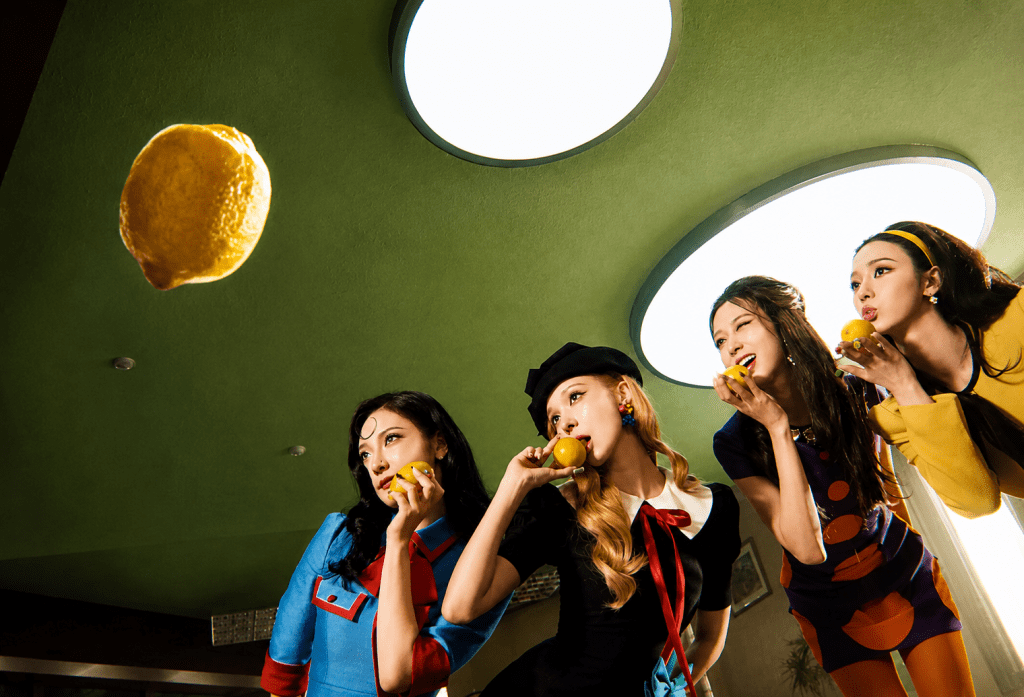
What makes LEMONADE so fascinating is that it does not treat transformation as something smooth or pretty.
The title might suggest a simple message: when life gives you lemons, make lemonade. But aespa make that idea stranger, sharper and more physical. In the lyrics, the lemons are not gently squeezed into a glass. They are mixed, stirred, crushed, swallowed. Problems become ingredients. Chaos becomes flavour. Pressure becomes fuel.
And the music does the same thing.
Stop. Restart. Mutate.
LEMONADE opens like a trick. The first metallic synths immediately place us inside aespa’s familiar sound world: artificial, chrome-like, slightly strange, almost mechanical. Then another layer arrives, with the voice entering over a sand-like shaker rhythm. At first, it feels as if the song is giving us the verse. But then the beat grows, the track seems ready to open into a bigger EDM moment, and suddenly Karina cuts through it: “Wait, hold up, no.”
That stop changes everything.
Instead of giving us the expected release, the song folds back on itself and reveals that what we thought was the verse may have been something closer to the chorus, or at least a fake opening section. The real verse arrives after the interruption, carried by a harder, emptier beat: that “tu-tu-cha” pulse, sharp and spacious at the same time. The metallic flute-like synth moves around it, while the bass doubles the beat and gives the whole section more weight. It is playful, but also controlled. aespa are not just riding the production; they are constantly redirecting it.
That is why the stop-start structure matters so much.
At first, the pauses sound like classic pop tension: a way to create suspense before the beat returns. But in LEMONADE, the stops feel more meaningful than that. They are interruptions built into the body of the song. “Wait, hold up, no.” “Wait, oh my God, stop.” “Wait, hold up, stop.” These are not just ad-libs. They sound like commands, as if the track is controlling its own movement, cutting itself off before anyone else can.
And this is where the contradiction becomes brilliant. The chorus tells us, “Don’t step on the brakes,” but the production keeps braking. The song stops, restarts, removes the beat, brings it back, changes the texture, adds new synths, shifts the vocal flow, then throws us forward again. It is not a straight line. It is a sequence of impacts.
But maybe that is the point.
LEMONADE is not about never stopping. It is about turning every stop into another launch. Every pause becomes pressure. Every interruption becomes part of the build. Every cut gives the song the chance to come back in a different form.
Drama straight, karma straight
The lyrics make this even clearer. “I take my drama straight” immediately feels like an internal aespa reference, because Drama is not just a word here: it is part of their own history. Then the line shifts later into “I take my karma straight,” which makes the idea even sharper. Drama becomes karma. External chaos becomes something aespa absorb, process and throw back with control.
The Korean lines push this transformation further. “겁 없이 walk my way” means walking without fear. “던져 on my stage” suggests throwing everything onto their stage: problems, pressure, judgement, whatever comes. But the second verse is where the lemonade metaphor becomes almost physical. The tangled problems are “mixed.” The pieces are stirred like a hurricane. The lemons are ground up and drunk. This is not soft optimism. It is consumption. It is conversion. It is aespa taking something sour, difficult and chaotic, then forcing it into a new shape.
Even the attitude is important. “무표정으로 난 savour” suggests savouring it with a blank expression. That is such an aespa detail: cold, composed, almost robotic, but still powerful. They are not dramatically collapsing under pressure. They are tasting it. Swallowing it. Performing it.
That is why the bridge feels like a release, but not a sentimental one. “Ain’t no emergency contact” is almost funny in how independent it sounds. There is no rescue call. No panic button. No one needs to come and save them. Everything becomes “a party” for them, and then the world opens wider: “welcome back to my world.” That line matters because it pulls LEMONADE back into aespa’s larger universe. The song is not only about personal confidence. It is about entering a bigger aespa world where chaos, flavour, danger and performance all become part of the same system.
Musically, the bridge into the final chorus is where this idea becomes explosive. The softer Part C does not simply slow the song down. It opens space. The beat disappears, foggy textures appear, the drums begin rising again, and then the track plays another game of stops before Winter stretches “lemonade” into the final build. It feels like the song is being pulled apart and reassembled in real time.
That passage is the genius moment.
By the final chorus and outro, the voices multiply into chants, harmonies and bright group textures. The song becomes fuller, not because it suddenly changes identity, but because every interruption has added pressure. Every stop has made the final release stronger.
From retro sweetness to acid apocalypse
This is also why the music video feels so connected to WDA. In WDA, aespa were becoming a “whole different animal”: creature and machine, body and system, mutation and glitch. LEMONADE takes that same idea and translates it into chemistry. The animal mutation becomes a citrus reaction. The green screen becomes an empty yellow world. The toxic green becomes lemon acid. The unstable body becomes something crushed, mixed and remade.
The visuals push this constantly. Lemons appear everywhere, but rarely as simple fruit. They become windows, walls, shapes, metallic objects, smoky forms, underground forces. A black lemon moves beneath the surface and cracks the ground. And then a giant one rises like something ancient or apocalyptic. Even the backgrounds begin to come undone while aespa keep dancing, as if the world itself is being squeezed apart.
That is what makes the concept so strong. LEMONADE is not just a song about confidence. It is a song about transformation under pressure. The members are not avoiding the chaos around them. They are swallowing it, remixing it, performing it and turning it into their own flavour.
Same aespa DNA.
New reaction.
If you enjoyed this deep dive, follow @choeaenotes on Instagram for more K-pop reviews, concepts and comeback breakdowns.
Sources consulted
Official music video, album information, lyric translations and selected coverage were consulted alongside personal listening notes. These included aespa’s official LEMONADE music video, Apple Music album information for LEMONADE – The 2nd Album, Vogue’s behind-the-scenes feature on the LEMONADE video, Chosun/OSEN coverage of the album release, and lyric translation sources used to cross-check the Korean lines. These sources were used to confirm factual details such as the album framing, the MV’s retro/mod styling, the “sour” version of aespa described in promotional coverage, the wider LEMONADE album context, and the general meaning of the Korean lyrics. The main interpretation, music analysis, visual reading and overall argument are my own.


Leave a comment