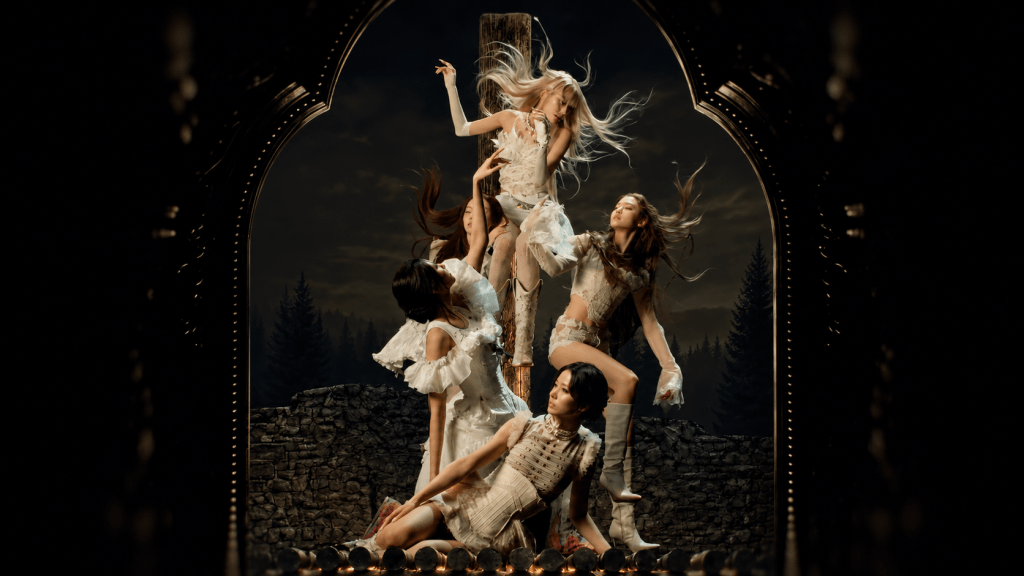
MEOVV took a Bach sample and built an entire gothic K-pop ritual around it.
That is the first thing that makes “DDI RO RI” interesting. Not simply that it uses classical music. K-pop has played with classical references before, sometimes as decoration, sometimes as drama, sometimes as a shortcut to grandeur. But here, the sample is not just placed on top of the track to make it sound expensive or theatrical. It becomes the door into the whole concept.
The opening organ motif immediately creates tension. It feels old, haunted and ceremonial. Then the song pulls that gothic energy into a sharper, more modern space: hip-hop/trap attitude, electronic build-ups, performance-driven sections and a chant-like ending that makes the title feel less like a phrase and more like something stuck inside your head.
That is important, because “DDI RO RI” is not built around softness or emotional confession. It is built around presence. The song is about entering a space and changing its temperature. Being watched. Being feared. Being copied. Being remembered.
The track understands the power of repetition, but what makes it work is that the repetition is not only musical. It is lyrical, visual and physical. The sound, the lyrics, the styling, the choreography and the music video all point in the same direction: MEOVV are not asking for attention. They arrive like a warning.
The sample as architecture
The most important musical choice is the use of Bach’s Toccata and Fugue in D minor. That piece already carries a huge amount of cultural baggage. Even for listeners who do not know the title, the organ sound is instantly recognisable: horror, churches, shadows, old cinema, vampires, haunted houses, dramatic entrances. It is one of those melodies that arrives with an atmosphere already attached to it.
MEOVV use that atmosphere wisely.
The sample is especially present in the introduction and around the chorus, where it acts almost like a gothic frame around the track. It gives “DDI RO RI” its haunted identity, but the song does not stay trapped in the past. Instead, the production drags the classical motif into a modern K-pop performance space.
The result is not pure horror.
It is horror filtered through fashion, attitude and choreography.
That contrast gives the song its bite. The organ suggests something ancient and ceremonial. The beat brings it back to the club. The rap sections make it confident and confrontational. The electronic build-ups sharpen the energy. By the time the chant-like ending arrives, the song feels less like a story and more like an incantation.
This is where the title becomes clever. “DDI RO RI” does not need to function like a normal lyric with a clear meaning. It works like a sound effect, a melody, a warning, a mental loop. The song itself plays with that idea by describing its sound as something that echoes in the listener’s mind. The title becomes the thing it talks about: catchy, strange, intrusive, impossible to fully shake off.
Threat, bite and control
The lyrics make the concept sharper than it first appears.
At surface level, “DDI RO RI” has plenty of classic K-pop confidence: trend-setting, being ahead, ignoring the rest, entering the scene with power. But the interesting part is how that confidence becomes predatory rather than just glamorous.
The song starts with scale. MEOVV place themselves in an arena-like space, moving from Korea to Ibiza, already positioned as performers with global reach. Then the lyrics quickly shift from public spectacle to something more dangerous. They talk about hiding their true nature, staying low-key, and fooling everyone who underestimates them.
That is a key idea in the song: the threat is not loud at first.
It waits.
The “bite” image then makes the album title feel much more connected to the track. BITE NOW is not just a catchy phrase or a feline reference. In “DDI RO RI,” biting becomes a gesture of instinct and control. The lyrics describe vulnerability, closeness and attack in the same breath. It is not romantic softness. It is hunger dressed as performance.
This matters because MEOVV’s group identity already plays with feline energy: sleekness, sharpness, beauty, danger. But here, that identity grows teeth. They are not being cute about it. They are turning the cat image into something more predatory, more physical and more theatrical.
The chorus reinforces this with the line “walk in like a threat.” That phrase summarises the whole song. MEOVV’s power is not framed as a request for approval. It is an entrance. A disruption. A change in atmosphere.
They do not say, “look at me.”
They say: you already noticed.
A song designed to get inside your head
The other important lyric idea is mental invasion.
The song repeatedly frames “DDI RO RI” as something heard, remembered and replayed internally. It is not just a chorus. It is a sound that follows you. That connects directly to the structure of the track, because the hook is deliberately circular. It does not unfold like a big emotional release. It loops. It returns. It gets sharper through repetition.
That is why the lyric about hearing the song “inside your head” feels central rather than throwaway. The track is describing its own effect.
This is one of the reasons the Bach sample works so well. Toccata and Fugue in D minor is already a melody with cultural memory attached to it. Many listeners recognise it even if they cannot name it. MEOVV take that familiar haunted sound and attach it to a new hook. So the song becomes a double earworm: the old organ memory and the new title phrase working together.
There is also a clever tension between distance and possession. The lyrics tell others to watch, keep distance, make way, and avoid casual access. But at the same time, the song insists that its melody will still reach the listener’s mind. You may be kept at a distance physically, but the sound still gets in.
That is a very strong pop idea.
The listener is pushed away and pulled in at the same time.
The blueprint of newness
Another lyric thread is newness.
MEOVV repeatedly position themselves as ahead of the curve: trend-setters, one of a kind, operating on something new. This could easily sound generic, because K-pop often uses confidence language. But in “DDI RO RI,” the production makes the claim feel more convincing.
The song is not simply saying MEOVV are new. It behaves strangely enough to support that claim.
The classical sample is recognisable, but the track refuses to become a straightforward classical-pop hybrid. The trap/hip-hop rhythm keeps it grounded in attitude. The electronic sections push it toward performance intensity. The chorus is catchy without becoming sweet. The ending turns into a chant without becoming a simple party hook.
So when the lyrics talk about being the blueprint or ignoring the rest, they are not only bragging. They are building a self-image: MEOVV as the model, not the copy. The original pattern. The thing others will try to follow later.
That is where “DDI RO RI” feels connected to MEOVV’s larger branding. Their name, styling and sound all lean into sharpness and charisma, but BITE NOW makes that identity more dangerous. It says: we are not only polished. We are instinctive. We are not only stylish. We can attack.
Horror, but make it high fashion
The music video understands the song’s theatricality and pushes it further.
Instead of giving us a simple dark concept, the MV builds a visual world around contrast: white and red, stillness and movement, glamour and threat, beauty and discomfort. There is horror imagery, but it is not cheap horror. It is polished, glossy and stylised. The spaces feel part mansion, part church, part gallery, part nightmare.
The white styling gives the members an angelic, almost porcelain-like quality at first. But that angelic image never feels innocent. It feels uncanny. Too perfect. Too still. Too aware of the camera.
This is one of the strongest visual choices in the video: MEOVV are not presented as victims inside a horror world. They are the ones controlling it.
Then the colour story shifts.
The move into red feels like the concept revealing its true nature. Red leather, red bodies, red movement: suddenly the video becomes warmer, sharper and more dangerous. It is as if the hidden instinct in the lyrics has finally taken physical form.
That is why the red sections work so well. They are not only visually striking. They feel like the moment the “bite” becomes visible.
Mirrors, doubles and unstable identity
One of the most interesting parts of the MV is the use of mirrors and doubles.
The video repeatedly plays with reflection, duplication and split identity. The members appear multiplied, framed, watched or mirrored. It creates the feeling that the self is unstable — that there is always another version looking back.
This fits the horror-coded atmosphere, but it also connects to the lyrics. “DDI RO RI” is full of control: controlling the room, controlling the viewer’s attention, controlling the melody that repeats in the mind. The mirrors make that control more unsettling. They suggest that image itself can multiply, distort and trap.
MEOVV are glamorous, but there is something strange underneath the glamour. They are composed, but the composition feels threatening.
The mirrors do not simply say “look at us.”
They say: you cannot look away.
That is a different kind of confidence. Not just beauty. Not just attitude. Confidence as disturbance. Confidence as possession. Confidence as the ability to haunt the viewer after the video ends.
Art history, religion and performance
The video also has a strong art-historical feeling.
There are moments that recall Renaissance and Baroque visual codes: dramatic framing, staged bodies, ceremonial poses, religious undertones, rich textures and compositions that almost look like paintings. Some scenes feel like a triptych, with figures arranged as if inside a painted panel or altar-like structure.
This matters because it connects the visual world back to the music.
If the Bach sample brings in Baroque drama through sound, the MV answers with visual drama: bodies posed like icons, rooms that feel ceremonial, lighting that turns performance into spectacle.
This is why the classical reference does not feel random. It is not only in the audio. It spreads into the whole aesthetic.
The organ sound belongs to the architecture, the styling, the religious shadows, the staged bodies and the choreography. Everything feels part of the same strange ceremony, but the video never becomes old-fashioned. The styling keeps it modern. The performance keeps it sharp. The editing keeps it restless.
It is historical atmosphere rewritten as K-pop spectacle.
The choreography: controlled chaos
The choreography also carries the concept.
There is something almost zombie-like in the movement at certain points, especially when bodies gather, repeat and move with controlled but unsettling energy. It does not feel messy. It feels deliberately strange. The dancers become part of the track’s machinery, like a crowd pulled by the same sound.
This is where the video becomes really fun. The red figures are almost like fashion zombies: glamorous, coordinated, threatening and slightly absurd in the best way. They bring horror energy into a performance space without losing the editorial quality of the visuals.
The choreography does not only decorate the song.
It completes it.
The repeated title, the bite imagery, the organ motif, the red styling and the group formations all turn “DDI RO RI” into something circular and infectious. The song does not progress in a traditional emotional way. It circles, returns, repeats and intensifies.
Like a chant.
Like a spell.
Like something designed to be performed again and again.
Why the experiment works
The reason “DDI RO RI” works is not because every element is subtle. Actually, the opposite is true. It works because MEOVV fully commit to the excess.
A Bach organ sample. Vampire-coded imagery. Mirrors. Red leather. Angelic styling. Horror choreography. Ritual framing. Hip-hop confidence. EDM tension. It could easily become too much. But the whole point is that it is too much. That is the spectacle.
What saves it from feeling like a gimmick is the consistency of the world-building. The song and MV understand each other. The sample creates the mood. The lyrics sharpen the threat. The visuals give it a body. The choreography turns it into performance.
Even when the track moves into more contemporary K-pop territory, the gothic frame remains present.
This is also a smart move for MEOVV as a group. Their name and branding already play with feline identity, sleekness and sharpness. BITE NOW pushes that further by making the “bite” more dangerous, more theatrical and more conceptually charged. It is not just cute cat imagery. It is instinct, hunger and transformation.
Final thought
“DDI RO RI” is one of those K-pop releases that understands the value of committing to a concept.
It takes a classical sample that could have been used as a simple dramatic intro and turns it into the foundation of a whole visual universe. It brings together gothic horror, high fashion, ritual imagery, vampire energy and performance power without watering any of it down.
The result is theatrical, strange, polished and slightly unsettling — exactly the kind of release that makes you want to pause, replay, and look again.
MEOVV have not just sampled Bach.
They have turned him into a K-pop séance.
And honestly?
Watch out.
If you enjoyed this reading, follow ChoeAe Notes for more K-pop deep dives, comeback reviews and visual/music analysis.
Sources consulted
Official MEOVV / THEBLACKLABEL materials, the “DDI RO RI” music video, Korea JoongAng Daily, StarNews, allkpop, Inkistyle and selected music/classical context sources were consulted to confirm release details, track information, lyric references, the Bach sample and visual context. The interpretation, structure and overall argument are my own.


Leave a comment